
- Ijeoma Chinaka Ezeude
- LLB, BL, LLM (University of Nigeria); PhD, Public Law (University of Nigeria)
- IC Ezeude ‘Examination of access to justice barriers for children with disabilities in Nigeria’ (2025) 13 African Disability Rights Yearbook 29-55
- https://doi.org/10.29053/adry.v13i2.5529
- Download article in PDF
Summary
Improving access to justice for the enforcement of rights of children with disabilities remains arduous for the Nigerian Government. This constitutes a drawback to the actualisation of the purpose and objectives of the global international human rights standards on disability rights, to which Nigeria is a state party. Despite the enactment of the Discrimination Against Persons with Disabilities (Prohibition) Act, 2018, the inability of the country to effectuate the provisions of the law, has continued to widen the scale of rights abuses of children with disabilities. Children with disabilities continue to be pervasively abused and, in many instances, used as catalysts for the invocation of pity in alms begging. The increasing number of children with disabilities roaming the streets of major cities across Nigeria underscores the importance of this paper. At the hub of these implementation challenges are a lack of infrastructural, technological and manpower assistive devices to assist children with disabilities to wit: disability curb cuts, lifts, ramps, braille, screen readers, switch devices for accessibility to court rooms, police stations and other justice buildings; and a lack of technical and qualified expertise to handle disability cases. The aim of the research is to examine the barriers to access to justice for children with disabilities, in doing so, the work adopted a mix of doctrinal and empirical approaches to discussing these barriers faced by children with disabilities. The doctrinal approach reviewed the extant law on disability in Nigeria, whilst the empirical approach involved the distribution of online surveys and questionnaires to participants across the six geo-political zones in Nigeria to get their views on the way forward in addressing these challenges. Lastly, the work advocates for concerted collaborative efforts by key stakeholders through action plans, policy strategies, efficient institutional mechanisms, and effective monitoring and accountability for these implementation gaps to be effectively addressed.
1 Introduction
Since 1989, the rights of children have been given due recognition in a plethora of instruments globally. The first treaty to recognise the rights of children is the United Nations Convention on the Rights of the Child (CRC) of 1989.1 The CRC emphasises ‘the right to a full and decent life, in conditions which ensure dignity, promote self-reliance and facilitate the child’s active participation in the community’.2
The Committee on the Rights of the Child is also clear that special measures or adaptations may be needed to ensure that children with disabilities have their rights equally respected, protected, and fulfilled when they are accessing justice.3 The United Nations Convention on the Rights of Persons with Disabilities (CRPD) of 2006 also reinforces the rights of children with disabilities.4 The CRPD provides that ‘States Parties shall take all necessary measures to ensure the full enjoyment by children with disabilities of all human rights and fundamental freedoms on an equal basis with other children’.5 Nigeria ratified the CRPD in 2007 and its Optional Protocol in 2010.
At the regional level, The African Charter on the Rights and Welfare of the Child (ACRWC)6 together with the Protocol to the African Charter on Human and Peoples’ Rights on the Rights of Persons with Disabilities in Africa (The African Disability Protocol)7 also recognise the rights of the child. Nigeria domesticated the CRC in 2003 through the Child’s Right Act (CRA).8 In addition, Nigeria enacted the Discrimination Against Persons with Disabilities (Prohibition) Act (DAPDPA) of 2018. It has been put forward that:
The UNCRD has revolutionized the way the legal framework responds to the rights of persons with disabilities, it has the potential to help them come out of benevolence welfare mindset that creates a dependency syndrome.9
Despite the CRC, CRPD, ACRWC, and the Nigerian DAPDPA, reports show that children with disabilities are confronted daily with the challenges of enforcing their legal rights. These rights include the civil, social, economic, health and cultural rights of children with disabilities. According to the United Nations Children’s Fund (UNICEF) report in 2023, ‘children with disabilities are 25 per cent less likely to attend early child education [and] 47 per cent more likely to be out of primary school’.10 Similarly, the United Nations Educational, Scientific and Cultural Organisation (UNESCO) report in 2023 indicates that ‘the global number of out of school children has risen by 6 million since 2021 and now totals 250 million’.11 These figures are undoubtedly accentuated by the lack of access to justice to enforce their legal rights.
The main purpose of the paper is to highlight these barriers facing children with disabilities and to recommend that concerted collaborative efforts by key stakeholders in the area of implementation of the rights of children with disabilities are imperative in Nigeria, through action plans and effective strategic policy implementation.
The paper is divided into seven parts. Part one is a general introduction, part two aims to define the concepts of rights, disability and access to justice for more clarity. Part three problematises the discourse of disability by raising some hypothetical problem questions to buttress several challenges facing children with disabilities in the justice system. Part four discusses the international, regional and national responses to access to justice for children with disabilities with a view to finding out the extent to which the right of access to justice of children with disabilities has received global recognition. Part five discusses the barriers of access to justice by critiquing the relevant parts of the Nigerian DAPDPA requiring urgent implementation so as to improve access to justice for children with disabilities. Part six analyses the empirical approach through surveys and questionnaires to participants, to get their perspectives on ways of addressing access to justice challenges for children with disabilities. Lastly, part seven is the conclusion with recommendations on ways to improve access to justice for children with disabilities in Nigeria.
2 Understanding the concepts of rights, disability and access to justice
Right is derived from the Latin word ‘rectus’ which in the noun form means that to which a person has a just and valid claim. This connotes the capacity of doing an act or an interest to be benefitted by the holder of such right. A right is an indispensable valuable possession; a world without rights no matter how full of benevolence and devotion to duty would suffer an immense moral impoverishment.12
A jurist, Oputa, in one of his prolific writings called it ‘a legal right and the capacity residing in a person or group of persons of controlling, with the assent and the assistance of the state, the action of others’.13 Oputa’s definition can be said to mean that every person has a legal right for the sake of being human and the right of a person therefore demands from the other party, to either perform or refrain from performing certain actions. Children with disabilities as children therefore possess legal rights. These rights of children, including children with disabilities, were prominently espoused with the adoption of the League of Nations in 192214 and the 1959 Declaration of the Rights of the Child.15 The CRC was ushered in as the first legally binding instrument on children’s rights.16 The CRC also specifically recognised the rights of children with disabilities.17 For a proper understanding of who a child with disability is, the paper shall define ‘disability’ first.
Disability is defined as ‘resulting from the interaction between persons with impairments and attitudinal and environmental barriers that hinder their full and effective participation in society on an equal basis with others’.18 The definition of ‘disability’ under the CRPD signifies that ‘disability’ is a combination of genetic and environmental factors; the CRPD therefore provides a shift away from a purely medical model to social realities which incorporates a transformative view of disability.19 The social model strives to transform children with disabilities’ limitations through eliminating discriminatory practices and social barriers in the society.
Similarly, in Nigeria, disability is defined under the DAPDPA to include ‘long term physical, mental, intellectual or sensory impairment which in interaction with various barriers may hinder full and effective participation in society on equal basis with others’.20 The Nigerian CRA defines ‘a child in need of special protection measures as a child who is mentally or physically impaired’.21 Therefore, a child with disability according to the social model of disability is a child hindered by societal barriers to exercise his/her legal rights. These legal rights include the right to development, right to health and right to access to justice which is the main subject of this discourse. What then is the concept of access to justice?
Access to justice is a fundamental principle of the rule of law which encapsulates the right to be able to approach the mechanisms of justice.22 Access to justice therefore includes ‘normative legal protection, legal structures and procedures, legal awareness, legal aid and legal advice, enforcement of rights and civil society oversight’,23 and is broader in scope and entails the protection of the law and whatever rights are protected by the law must be enforced without any forms of hindrance.24 Access to justice has been identified to have three distinct components to wit: substantive, procedural and symbolic.25 For children with disabilities, the procedural access to justice requires particular attention in Nigeria so as to remove barriers that prevent them from participating actively in court proceedings.
In the next sections, the paper will explore the problematisation of access to justice and the normative framework for access to justice.
3 Problematisation of the discourse
Three hypothetical examples follow. A 13-year-old girl with a sensory disability is defiled, she has no legal assistance and even her legal representative sees her as a burden. Who will take this girl’s case to court and as a child with sensory disability who will challenge her legal representative who has refused to protect her right?
A group of girls with intellectual disabilities have been serially deceived and sexually abused and used in soliciting alms along the streets. Who will assist these girls when their case is finally brought to court? Who will ensure they are heard? Who will support them in expressing themselves? What guarantees are there that the court will accept their testimonies as evidence?
A 12-year-old girl with Down syndrome has been raped and becomes pregnant. Her parents and the court believe that she is still too young to give evidence. They decide to do a caesarean operation and give the baby up for adoption. Nobody asks the girl questions about the rape incident as to whether she will recognise the perpetrator or whether she is capable of understanding that she was pregnant and whether she could have taken care of the baby. Who will take her case to court and see that she is heard? Who will have the patience to understand what the girl is capable of doing and the assistance she wants and needs? Who will protect her right as a child and as a mother?
These issues are core principles for this discourse and throw more highlights on the imperatives of navigating these implementation challenges in the enforcement of rights of children with disabilities in Nigeria as recent statistics hereunder stated reveal the pervasiveness of these problems which is becoming endemic.
It is reported that children with disabilities are most often deprived of early opportunities in life to develop and participate fully in society.26 They frequently face disproportionate levels of marginalisation and exclusion as well as higher levels of violence, exploitation, abuse27 and poverty.28 The UN Children’s Committee29 states that:
Children with any kind of impairment encounter a combination of social, cultural, attitudinal and physical obstacles to the realization of their rights and that action is needed to remove those barriers to ensure that they are treated equitably and without any discrimination and to ensure that their best interests are taken into account as a primary consideration.
Reports also reveal that children with disabilities find it more difficult to access education30 and healthcare.31 Girls with disabilities face a higher risk of violence and neglect than other girls.32 Children with disabilities who live in areas affected by emergencies, disasters, or armed conflict also face heightened challenges.33
The United States Department of Justice reported that the rate of violent victimisation against persons with disabilities was 2.5 times higher than those without disabilities.34 Persons with disabilities face disproportionate socio-economic marginalisation resulting in poorer health and medical conditions, lower quality of education, and limited employment. In the case of children, it has been reported that children with disabilities are most often deprived of early opportunities in life to develop and participate fully in society, they are frequently denied access to equal opportunities for learning and are also at more vulnerable risk of abuse and violence, yet their testimonies are often ignored or dismissed.35 Mercy Gichuhi, Country Director, Save the Children International Nigeria, stated:
Children, girls and women with disabilities are the most affected and disadvantaged in times of disaster, armed conflict or humanitarian crisis, they are often neglected as part of communities during recovery and response programs.36
Children with disabilities in Nigeria are rampantly abused and, in many instances, used as a catalyst for invocation of pity used in alms begging in major metropolitan cities across Nigeria.37 Children with disabilities are seen begging for alms near traffic lights, restaurants, shopping malls and churches, amongst other public places, in Nigeria.38 These children face different types of discrimination and have limited access to basic social services like health, legal and educational facilities.39
This paper advocates for concerted collaborative efforts by multi-sectoral stakeholders in the area of implementation of the rights of children with disabilities in Nigeria. These stakeholders must include the government, civil society organisations (CSOs), and public and private sector establishments which are imperative to account for the needs of children with disabilities.
4 Access to justice for children with disabilities: International, regional and national responses
Nearly all international, regional and national human rights instruments provide for the right of access to justice. Article 8 of the Universal Declaration of Human Rights (UDHR) provides that ‘everyone has the right to an effective remedy by the competent national tribunal for acts violating the fundamental rights guaranteed to him by the constitution or by law’. The International Covenant on Civil and Political Rights (ICCPR) provides that ‘all persons shall be equal before the courts and tribunals’.40 Article 14(2)(f) of the ICCPR provides that with respect to criminal proceedings, every person has the right to have the free assistance of an interpreter if he cannot understand or speak the language used in court. It is worthy to note that the CRC remains at the core with the principle of the ‘best interests of the child’ considered as one of the fundamental principles to guide all the procedures and policies regarding children and their access to justice.41 The CRPD which was ushered in later has added impetus to the right of access to justice and promotes the shift towards a social model of disability. Article 13(1) of the CRPD sets out that governments shall:
Ensure effective access to justice for persons with disabilities on an equal basis with others, including through the provision of procedural and age-appropriate accommodations, in order to facilitate their effective role as direct and indirect participants, including as witnesses, in all legal proceedings, including at investigation and other preliminary stages.
The CRPD therefore makes it obligatory for government to promote the training of professionals working in justice systems to ensure that people can access justice on an equal basis with others.42 The government’s obligations are to be read together with the CRPD provisions in article 9 which ensure the full inclusion of persons with disabilities in society through ‘identifying and eliminating barriers to justice’ including those that are attitudinal.
At the regional level, the ACHPR in article 7 recognises the right to a fair hearing for every person. Nigeria has since ratified and domesticated the ACHPR43 thereby making it part of Nigerian municipal law in line with the Constitution of Nigeria.44 Additionally, the ACRWC provides as follows:
In all judicial or administrative proceedings affecting a child who is capable of communicating his/her own views, an opportunity shall be provided for the views of the child to be heard either directly or through an impartial representative as a party to the proceedings, and those views shall be taking into consideration by the relevant authority in accordance with the provisions of appropriate law. 45
The African Disability Protocol,46 ensures that states parties take measures to ensure that persons with disabilities have access to justice on an equal basis with others.47 The European Convention on Human Rights (ECHR) provides that access to remedies must be guaranteed on an equal basis to everyone without discrimination.48 Also the Charter of Fundamental Rights of the European Union (EU Charter)49 in particular provides for the right to fair hearing within a reasonable time. Everyone has the right to receive legal advice, a defence and representation and a restatement of the presumption of innocence.50
Access to justice is embedded in the Constitution of the Federal Republic of Nigeria, 1999 (As amended 2023) (CFRN). Section 46(1) of the CFRN guarantees every person the right to enforce his/her fundamental rights where it provides that:
Any person who alleges that any of the provisions of this Chapter has been, is being or likely to be contravened in any State in relation to him, may apply to a High Court in that State for redress.
In pursuance to this provision of the Constitution, the Fundamental Rights (Enforcement Procedure) (FREP) Rules were made by the Chief Justice of Nigeria (CJN) deriving powers under section 46(3) of the CFRN, so as to further advance the course of justice in cases of human rights.51 The importance of the FREP Rules, which emerged as an additional advantage to the African Charter is that it makes the Charter applicable in its procedural framework.52 The FREP provision also enables the court to proactively ‘pursue enhanced access to justice for all classes of litigants especially ... the vulnerable’.53
Drawing from the above provision of the FREP Rules, it is worthy to note that for children with disabilities, special assistive devices shall be provided to ensure effective access to justice. Nigerian courts are yet to make pronouncements on cases involving the enforcement of the right of access to justice for children with disabilities. In recognising the need for special measures to be taken in matters involving children with disabilities. The Nigerian CRA, applicable only in the Federal Capital Territory of Nigeria,54 provides that:
Every child who is in need of special protection measures has the right to such measure of protection as is appropriate to his physical, social, economic, emotional and mental needs under conditions which ensure his dignity, promote his self- reliance and active participation in the affairs of the community ...
Every person, authority, body or institution that has the care or the responsibility for ensuring the care of a child in need of special protection measures shall endeavour, within available resources, to provide the child with such assistance and facilities which are necessary for his education, training, preparation for employment, rehabilitation, and recreational opportunities in a manner conducive to his achieving the fullest possible social integration and individual development and his cultural and moral development.55
The above provisions of the CRA give credence to the importance of access to justice for children with disabilities whose rights must be adequately protected and safeguarded in the administration of justice.56 Nigerian courts have failed to make pronouncements regarding the barriers facing children with disabilities in enforcing their legal rights in court due to of lack of assistive devices in court rooms.
In a similar vein, the CRA establishes the Family Court for the Federal Capital Territory and for each State of the Federation for the purpose of hearing and determination of matters pertaining to children.57 The Act establishes two court levels of the Family Court to include the Division of the High Court at the High Court levels and at the Magistrates’ Court level.58
The Act provides that the Family Court shall have jurisdiction to entertain civil and criminal matters pertaining to the existence of legal rights, power, duty, liability, privilege, interest, obligation or claim in respect of a child or criminal proceeding relating to any penalty or other liability in respect of an offence committed by a child or against the interests of a child.59 The Act provides for the constitution of the Family Court when sitting on matters of children to include: a) Judges of the High Court of the State or Federal Capital Territory Abuja; and b) Assessors, who shall not be below the rank of a Chief Child Development Officers.60 The provision of having assessors who are professionals in child development is laudable. The law makes it mandatory for the Court to be duly constituted when sitting and such constitution shall include two assessors who have attributes of dealing with children. The Act replicates the same provisions on the constitution of the Court at the Magistrates’ Court level as well. The constitution of the Court at the Magistrate’s Court level shall also be magistrates not below the rank of Chief Magistrate, and also two assessors.
But the addition in the Magistrates’ Court is that one of the assessors shall be a woman and the other shall be a person who has attributes of dealing with children. The Act provides for adequate training, and refresher courses to be given to court personnel from time to time.61
The child has the right to be represented by a legal practitioner and is also entitled to free legal aid in the hearing and determination of any matter pertaining to a child.62 The privacy of the child in any proceeding is safeguarded by the Act where it provides that only the members of the Court, parties to the case, solicitors and counsel, parents and guardians of the child or any other persons involved in the case shall be in a court where proceedings relating to a child are done.63 The section also excludes members of the press.
The Act gives the Family Court exclusive jurisdiction in cases of children.64 The Act prohibits any child from being treated like an adult before the justice system.
Only few States in Nigeria including the Federal Capital Territory (FCT) have established the family courts. This adversely poses a challenge to the enforcement of the rights of children with disabilities. The deficiency in the number of Family Courts across the Country hampers the effective implementation of the CRA.65 Coupled with the fact that special measures as provided under the CRA in cases of children with disabilities appearing in court are still lacking. These special measures which include assistive devices for evidence taking among others constitute the gap which this study seeks to resolve. The challenges in providing special assistive devices in Nigeria also corroborate the research emphasis on the importance of moving beyond legislative enactments in providing special measures that will assist effective access to justice for children with disabilities. General provisions on the right of access to justice in extant laws discussed above cannot alone be sufficient in the exercise of the right of access to justice for children with disabilities who are in contact with the justice system in the absence of assistive devices.
A UNICEF report in 2023 revealed the inability of the Nigerian Government to submit child rights reports for the past 13 years.66 Reacting also to access to justice barriers in Nigeria, the UNICEF Child Protection Specialist in Nigeria in 2023, while commenting on this gap in implementation of the Child’s Rights Act, made an important statement on the need to look into enforcement challenges facing children’s rights especially the rights of children with disabilities as follows:
It is imperative that we have family courts in all the States that have adopted the CRA, without them, where will cases involving children be adjudicated? The absence of family courts undermines the protection and representation of vulnerable children and this negligence has grave consequences.
The Evidence Act (EA), 2011 of Nigeria provides for the competence and compellability of witnesses so as to enhance effective access to justice in giving evidence in courts as follows:67
All persons shall be competent to testify, unless the court considers that they are prevented from understanding the questions put to them, or from giving rational answers to those questions, by reason of tender years, extreme old age, disease, whether of mind or any other cause of the same kind ... A person of unsound mind is not incompetent to testify unless he is prevented by his mental infirmity from understanding the questions put to him and giving rational answers to them.
In the case of a witness with speech impairment,68 the EA provides that a person who is not able to speak, is a competent witness and compellable depending on the circumstances and can give evidence in any of manner which is intelligible such as writing or that the evidence shall be deemed to be oral evidence. Sebastine Tar on this premise, added that evidence of such persons will necessarily entail ‘calling expert interpreters, for easy comprehension thereof’.69
A witness who is unable to speak may give evidence in any other manner in which he can make it intelligible, as by writing or by signs but such writing and signs must be made in an open court.70
Such evidence shall be deemed oral evidence.71
The Administration of Criminal Justice Act (ACJA) applicable in the Federal Capital Territory of Nigeria72 is also relevant for protecting persons with mental impairment standing trial as follows:
Where in the course of a criminal trial, the court has reason to suspect the mental capacity or soundness of mind of a defendant, by virtue of which he is unable to stand trial or defend himself, the court shall order the medical examination of the defendant’s mental state or soundness of mind. 73
The National Mental Health Act (NMHA)74 is remarkable for expansively providing for the rights of persons in need of mental health conditions and provides for the right of a person with a mental health condition to access medical, social and legal services. 75
Undoubtedly, these salient substantive provisions on access to justice are commendable but efforts should be made to improve the procedural arm of access to justice in Nigeria by providing assistive devices in court rooms in Nigeria, so as to avoid these provisions from being mere academic rhetoric.
5 Barriers to access to justice: A review and critique of the rate of implementation of the DAPDPA
5.1 Attitudinal barrier
The DAPDPA provides for the full integration of persons with disabilities into society and established the National Commission for People with Disabilities charged with the responsibilities for their education, healthcare, social, economic and civil rights.76 The Act prohibits discrimination on the grounds of disability and penalises any person who discriminates against persons with disabilities.77 Section 16 prohibits the use of persons with disabilities in solicitation of alms. This section is currently not being enforced in Nigeria as the majority of persons with disabilities in Nigeria are street beggars.78 Some families in Nigeria use their children with disabilities to solicit for almsgiving along the major expressways.79 Yet the Nigerian Government has not arrested any person for such illicit conduct perpetrated against persons with disabilities.80
The Federal Ministry of Information is saddled with the responsibility for awareness creation,81 yet the awareness campaign has not been implemented as the consciousness to enforce the legal rights of children with disabilities among justice professionals still needs to be awakened.
5.2 Infrastructural and accessibility barriers
The DAPDPA provides for the accessibility of physical structures.82 The sections on accessibility clearly state that public physical structures should be modified to make them accessible to persons with disabilities.83 Public buildings whether movable or immovable should be modified to grant access to persons with disabilities,84 also road sidewalks and general facilities.85 A transitory period of five years is provided under the Act.86 Building plans should be designed with persons with disabilities in mind, especially those in wheelchairs. Government and relevant authorities are prohibited from approving building plans lacking in this regard. Persons with disabilities may seek redress in court by notifying the appropriate authority of the inaccessibility of the building.87 The Act provides punishment for failure to comply with provisions on accessibility.88
While this is a well-thought-out measure, it is important to note that most public buildings in Nigeria especially the court rooms lack sufficient infrastructural and assistive devices to guarantee access to justice for children with disabilities. The transitory period of five years is almost running out and there is no indication that the bodies will adhere to this mandatory provision.
The Act provides for the accessibility of vehicles.89 Public vehicles are mandated to display auditory and visual guides in their vehicles within five years of passing the Act.90 Transport providers are enlisted to frequent maintenance of the auditory and visual guides.91 Drivers owe a duty of care to persons with disabilities to come to a stop before alighting the vehicle.92 Currently, they do not have access to public transportation to courts. Available vehicles do not have assistive devices such as auditory and visual guides to aid persons with disabilities.
5.3 Communication barrier
The Act also entitles persons with disabilities access to assistive devices such as braille, screen readers, and sign language interpreters in court rooms. These assistive devices are important for receiving and taking evidence of children with disabilities as witnesses, claimants or respondents. The majority of courts in Nigeria lack these assistive devices as a result of inadequate funding. On the issue of lack of funding from the Nigerian Government, the provision in the CRA which provides for special protection measures and for institutions in charge of ensuring that the child in need of special protection ‘shall endeavour within available resources to provide the child with such assistance’ did not help matters.93 The phrase ‘available resources’ has been critiqued because it has given room for institutions not to provide assistance devices for children with disabilities on the grounds of limited resources even where the resources are available it may not be utilised. Ajanwachuku and Faga aptly critiqued the phrase ‘available resources’ as follows:
We argue that the inclusion of the clause ‘subject to available resource’ is a major clog in the full enjoyment of the provisions of the Act. We argue that the inclusion of this clause in the Act is tantamount to taking back with the left hand what the right hand has given. It would seem that the inclusion of the subject to available resources’ clause in the Child’s Rights Act was deliberate to render the rights of disabled children to the provision of special facilities and services non-justiciable as already contained in Chapter 11 of the Constitution.94
6 Empirical study
6.1 Research design and methodology
Due to the objective of this research, which emphasises an in-depth understanding of the barriers to accessing justice for children with disabilities, the quantitative research approach enabled the researchers to gain a deeper understanding of the experiences of children with disabilities through their parents and caregivers.
6.2 Procedure
The quantitative research involved the distribution of online questionnaires across the six geo-political zones in Nigeria. In addition, questionnaires were physically distributed to teachers and parents of children with disabilities in two special needs schools in the Southern and Northern parts of Nigeria namely: the Therapeutic School Abakpa Nike, Enugu; and Zamarr Institute of Special Needs, Abuja, Federal Capital Territory, Nigeria. The study was targeted particularly at getting information from parents and teachers of children with disabilities from their daily experiences.
6.3 Instrument, pilot testing and validation
The questionnaire was designed after a thorough review of relevant literature on the subject and validated by three experts - a university professor of Social Sciences and two associate Professors who are data analysts in the Department of Statistics, University of Nigeria.
The pilot testing was run through 30 respondents, 15 females and 15 males, who were either parents, caregivers or persons knowing a child with a disability. Feedback from these respondents did not constitute part of the final respondent’s results that were analysed.
6.4 Participants
Participants have been randomly recruited across the six geo-political zones in Nigeria. Five hundred (500) participants answered the research questionnaire. Two hundred (200) were online participants, while 300 participants were parents and teachers of children in two spotlight disability schools in the Northern and Southern regions of Nigeria.
6.4.1 Socio-demographic characteristics
Out of 500 administered questionnaires, 408 were returned completed, giving a response rate of approximately 82 per cent. The overall mean age of respondents is 30 + SD (Standard Deviation). Out of them 275 (67,4 per cent) were females. More than half of these respondents are single, that is 245 (60 per cent); 136 (33,3 per cent) are married; while 14 (3,4 per cent) are divorced. Considering their level of education, 320 (80,7 per cent) attained a higher educational level (Tertiary, Postgraduate); 74 (18,1 per cent) a lower educational level (Primary, Secondary); while 5 (1,2 per cent) attained none. The majority, about 383 (84,1 per cent) are employed and more than half of the respondents 273 (66,9 per cent) came from the Southern part of the country; the South-East recorded 197 (48,3 per cent), South-South 39 (9,6 per cent), South-West 37 (9,1 per cent), while North-Central 70 (17,2 per cent), North-West 33 (8,1 per cent) and the North-East about 32 (7,8 per cent).
6.5 Ethical consideration
The study was approved by the University of Nigeria Ethical Committee, College of Medicine Research and Ethical Committee (COMREC). A research proposal was submitted to the COMREC with some supported documents which included a consent form of participants as mandatory.
6.6 Data analysis
The data was analysed using the Statistical Package for Social Sciences (SPSS). The SPSS is a contemporary statistical analysis due to its easy-to-use graphical user interface. Although it offers a wide range of capabilities ranging from add-on packages such as Amos and Clementine. SPSS was first developed in 1968 and has since been used extensively in university research applications.95
6.7 Results of data analysis
About 20 per cent (85/408) of the respondents admitted to having a child with a disability (Table 2). The types of disability pointed out by these respondents include invisible, head injury, spinal, visual, mobility/physical, psychological, hearing and cognitive/learning disabilities. The result of this study revealed that out of 96 types seen in respondents’ children with disabilities, 39/96 (40,6 per cent) had cognitive/learning disabilities, followed by 16/96 (16,7 per cent) with hearing problems, and 26/96 (27 per cent) with physical or psychological disabilities. However, visual, spinal, head injury, and invisible disabilities made up the remaining proportion (Figure 1).
Figure 1: Types of disabilities reported by respondents who have children with disability
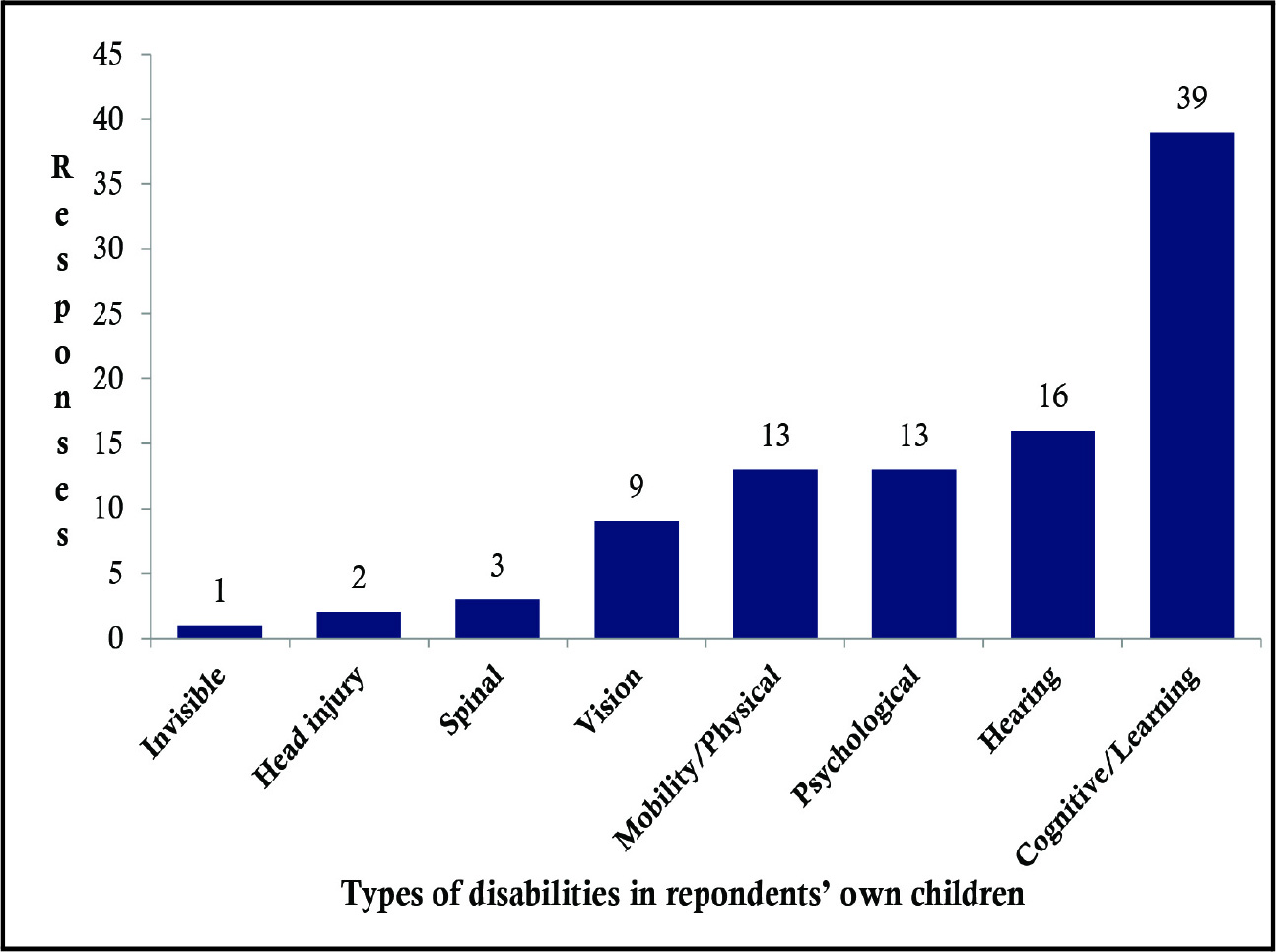
Only one respondent reported invisible disability, two respondents reported head injury, three respondents reported spinal cord injury, nine respondents reported visual disability, 13 respondents reported mobility and physical disability, 13 respondents reported psychological disability, 16 respondents reported hearing disability, while 39 respondents reported cognitive and learning disability.
A good number of the respondents, 267/408 (65,4 per cent) were found to know a child with a disability. Out of these children with known disability, 67/267 (25 per cent) have cognitive dysfunction, 54/267 (20,2 per cent) physical disability, 53/267 (19,9 per cent) hearing disability, 28/267 (10,5 per cent) visual disability, while spinal, head injury and invisible disability made up the remaining proportions (Table 4).
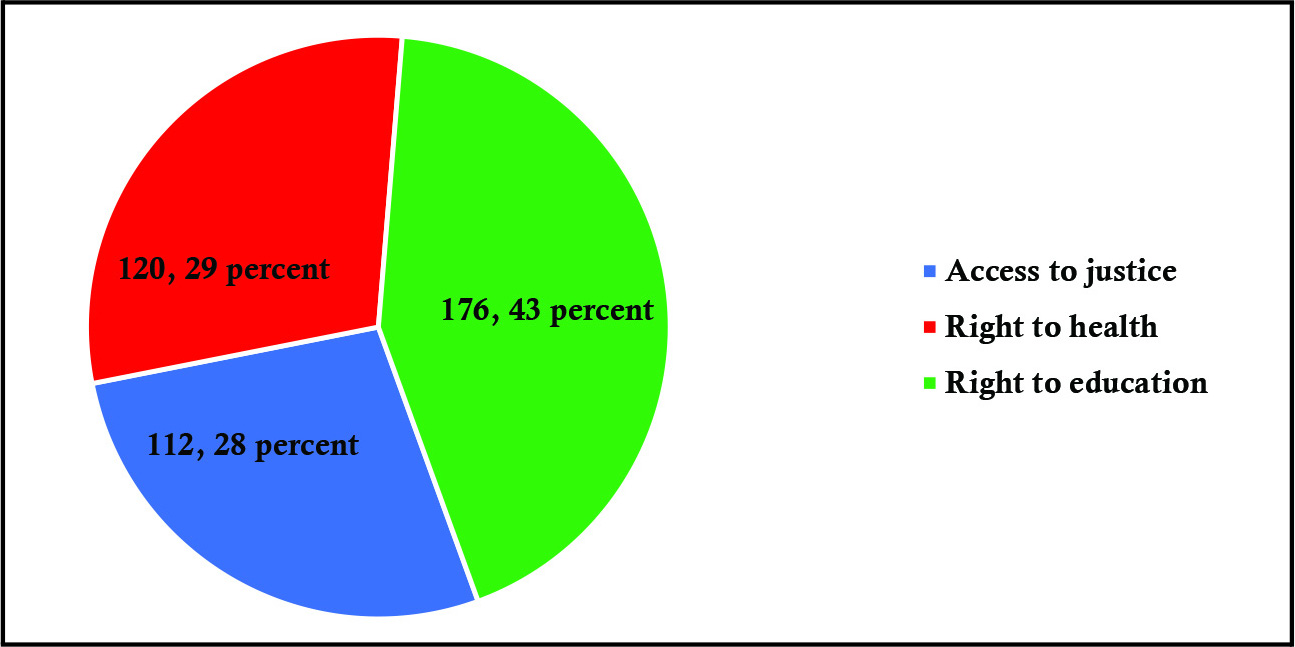
 Source: Author
Regarding the awareness of the legal rights of children with disability, 176 (43,2 per cent) respondents said that they are aware of children with disability’s right to education; 120 (29,3 per cent) admitted being aware of their right to health, while 112 (27,5 per cent) were aware of their right of having access to justice.
Figure 3: Respondents’ awareness of relevant laws in Nigeria protecting the rights of children with disability (N = 408)

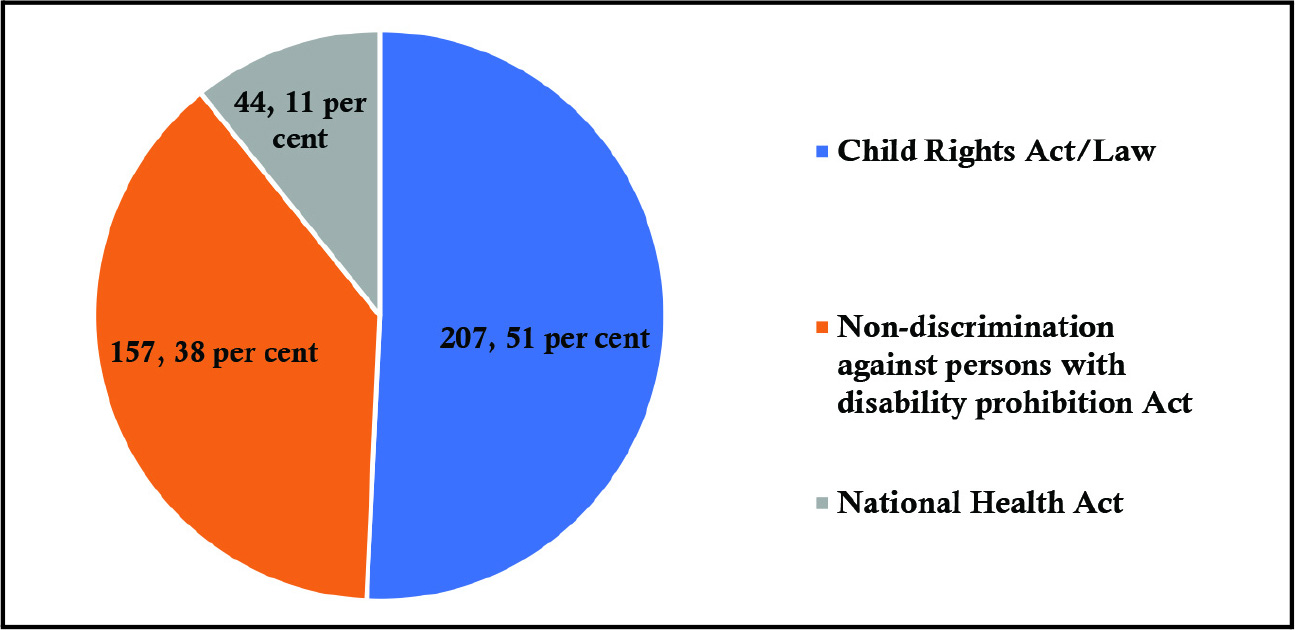
Respondents admitted being aware of relevant laws in Nigeria protecting the rights of a child with a disability. About half of them 207 (50,7 per cent) were aware of the CRA; 157 (38,5 per cent) of the Discrimination Against Persons with Disability (Prohibition) Act; and 44 (10,8 per cent) of the National Health Act.
Furthermore, when asked if they have access to the rights of a child with a disability in justice institutions, the majority, 371 (90,9 per cent) gave a ‘No’ answer (Table 5).
|
Access the rights of a child with a disability in justice institutions |
|||
Approximately 39 per cent (158/408) of the respondents strongly agreed that stigmatisation is a barrier to enforcing the rights of children with disabilities, 169 (41,4 per cent) agreed to the above assertion, 13 (3,2 per cent) disagreed, 32 (7,8 per cent), strongly disagreed while 36 (8,8 per cent) neither agreed nor disagreed to the notion (Table 6).
|
Stigmatisation is a barrier to enforcing the rights of children with disabilities |
|||
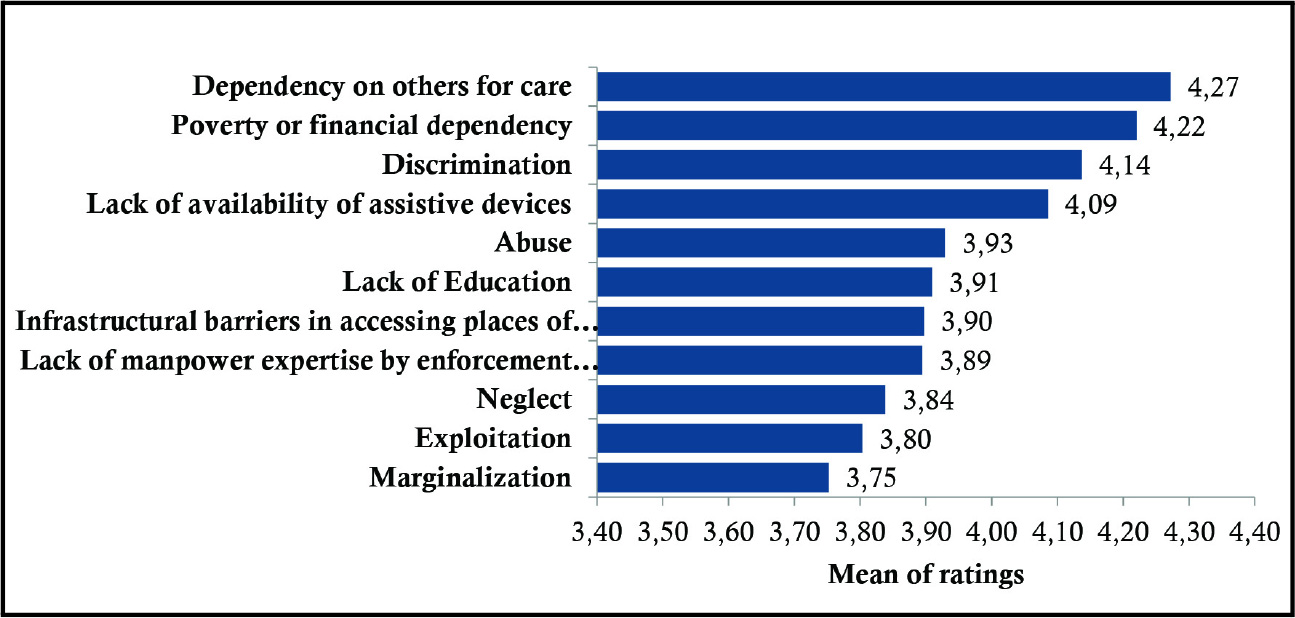
The influences of barriers to enforcing rights of children with disabilities as rated in this study include the following: marginalisation, exploitation, neglect, lack of manpower expertise by enforcement agencies, infrastructural barriers in accessing places of justice, lack of education, abuse, lack of availability of assistive devices, discrimination, poverty or financial dependency and dependency on others for care. The mean rates are shown in Figure 4 below.
Figure 4: Rating of influences of barriers to enforcing the rights of children with disabilities
Considering the impact of barriers affecting the enforcement of rights of children with disabilities, the majority of the respondents, 319 (78,2 per cent), agreed that these barriers can be decreased through effective justice and improving access to justice for the children with disabilities, 25 (6,1 per cent) disagreed, while 64 (15,7 per cent) remained neutral about it (Table 7).
7 Conclusion
The work in adopting both doctrinal and empirical approaches to the subject of disability discovered that so far in Nigeria there are adequate laws protecting the rights of children with disabilities, but the problem lies with improving access to justice in places of justice institutions to be able to enforce these legal rights of children with disabilities.
The rate of implementation of these laws is slow. The empirical approach of this work, which involved the administration of online surveys and questionnaires, reveals that some level of awareness of the existence of disability laws exists. Sensitisation is still paramount for more awareness creation on disability rights. But the crucial and immediate factor the participants noted was the importance of improving access to justice for children with disabilities which is imperative for enforcing the rights of children with disabilities in Nigeria. Some of these indicators that the participants highlighted that will help improve access to justice for children with disabilities in Nigeria include: the provision of disability ramps in buildings by the government, provision of adequate manpower, efficient and effective justice delivery system, and provision of technical aid interpreters in justice institutions. The absence of improved access to justice for children with disabilities will continue to compound the daily challenges they face in enforcing their legal rights to education and health, among others.
While the DAPDPA is a notable addition to the plethora of laws on disability rights, there is still room for improvement. The Disability Commission should be proactive in enforcing the provisions of the Act. They should also organise special awareness seminars for the public especially the justice professionals. Though efforts have been made by some states in Nigeria, example Lagos State and Anambra State in the area of sensitisation on disability rights, some persons are still oblivious that DAPDPA exists and hence need to know how to abide by the law. Special schools should be funded by the Government of Nigeria to enable access to free and comprehensive education for persons with disabilities. Educators and justice professionals should be mandated to undergo special training on the use of assistive devices and resources. Public buildings, especially the courts, should be modified with ramps and assistive devices for persons with disabilities to access them. Separate vehicles should be made available to transport persons with disabilities. These should be equipped with assistive aids and specially trained personnel. Pedestrian bridges should also be built along wide roads to enable them to cross the roads. Hopefully, the remaining transitory period will be put to good use to ensure that the rights of persons with disabilities are respected and upheld.
Multi-sectoral collaborative efforts through effective planning, policy strategies and institutional support are key. These efforts will encompass representatives from the Government, law enforcement agents, social protection and welfare, education, health communities, national human rights institutions, CSOs, and disability protection organisations for proper monitoring, evaluation, and accountability on the enforcement of the rights of children with disabilities in Nigeria. The Nigerian Government should live up to its responsibility of providing more funding for the institutional mechanism of enforcement, and provision of adequate disability technologically driven assistive devices in public places and justice institutions, among others. An example of a technological assistive device Nigeria can emulate is seen in the United States where the Federal Communications Commission oversees the services that allow persons with speech and hearing disabilities to use 711 service and video relay services. These services allow persons with disabilities to contact people with or without disabilities. This technological service can be replicated by the Nigerian Communications Commissions which is the regulatory body for the telecommunications company as it may not require much if the system in Nigeria is really efficient. The American Communications technology is widely recommended and worthy of adopting into the Nigerian telecommunication system.96 The Government should also co-operate with non-governmental organisations in the area of funding, because they are the ones that have data and their activities centre on these vulnerable groups including children with disabilities. Adequate data on the number of children with disabilities will enhance effective planning in every area of their lives, especially in education, health and legal sectors.
Periodic research should be conducted on the specific barriers that children with disabilities face in accessing justice. An increase in the networks and exchange of ideas and information between the multi-sectoral stakeholders should be encouraged.
More awareness and sensitisation campaigns through the media to raise awareness on breaking down the barriers on disability rights and to challenge the ills of negative societal stereotyping, and the right to equitable access to justice to engender positive attitudes towards disability.
Funding by the Nigerian Government of the institutional mechanisms is fundamental so as to monitor the progress rate of implementation. It is not encouraging that after five years of enacting the Nigeria Disability Act, the Commission set up under the Act to oversee disability implementation is still moribund and yet to operationalise its functions.
Justice institutions in Nigeria should be strengthened so that they can be effective, accommodating, friendly, and accessible. It is essential that interpreters should be employed in police stations and courtrooms.
The work strongly recommends a curriculum for teaching disability studies from the law degree programme in Nigerian Universities, through the Nigerian law school for training of prospective judges and lawyers. The resultant effect will be that by the time of call to the Nigerian Bar, prospective judges and lawyers will be fully trained in disability rights studies and will have mastered the art of disability adjudication. A typical example is in Kenya where several law schools and other institutions in Kenya have included disability rights studies in their curriculum.
Continuous capacity training of the justice sector, judges, lawyers, and law enforcement agents in the handling of disability cases is also imperative. Most of the CRPD Committee’s concluding observations emphasise the training of the judiciary, legal professionals, and court staff. More recent concluding observations on the issue of training are seen in those issued to New Zealand and Ecuador.
Lastly, technology has proved to be a useful tool to promote social inclusion, global development, and equality. The technology space is founded on innovations that allow people to access skills, education, and employment. Through technology and assistive technology like screen readers for persons with visual disabilities, braille displays, braille notes takers, electronic magnifiers, optical character recognition software (OCR), screen readout software, text-to-speech software, and alternative input devices persons with disabilities can be empowered to attain their full potential thereby activating their ability to compete favourably in society. It is also important that developers and designers understand assistive technologies and ensure the creation of apps, websites, and platforms that are disability friendly. Hence, a need for institutions to adopt disability-inclusive models/facilities, unique learning programmes, safe ICT spaces, and investment into research on the intersecting areas of technology and disability. Through strategic collaboration, actors can campaign and raise awareness of the potential of technology to overcome existing setbacks faced by persons with disability, especially children.
1. UN General Assembly, Convention on the Rights of the Child, United Nations, Treaty Series, vol 1577, p 3, 20 November 1989. Adopted and opened for signature, ratification and accession by General Assembly Resolution 44/25 of (20 November 1989), entry into force (2 September 1990), in accordance with art 49 https://www.unicef.org (accessed 5 November 2024).
3. UN Children’s Committee, General Comment 5: General measures of the implementation of the Convention on the Rights of the Child (arts 4, 42 and 44, para 6), 27 November 2003, UN Doc CRC/GC/2003/5 (2003) para 12.
4. A Flynn & J Hodgson ‘Access to justice and legal aid’ (2017) 39 Journal of Social Welfare and Family Law 522.
6. Organisation of African Unity (OAU), African Charter on the Rights and Welfare of the Child, CAB/LEG/24.9/49 (1990), 11 July 1990.
7. Nigeria formally ratified the African Disability Protocol on 19 October 2023 https://fmino.gov.ng (accessed 5 November 2024).
9. S Mukhopadhyay & E Moswela ‘Disability rights in Botswana: Perspectives of individuals with disabilities’ (2019) 31 Journal of Disability Policy Studies 1.
10. UNICEF ‘Fact sheet: Children with disabilities’ (August 2022) https://www.unicef.org/sites/default/files/2022-10/GIP02115_UNICEF_Children-with-Disabilities-Factsheet-final%20-%20accessible.pdf (accessed 19 August 2024).
11. UNESCO ‘250 million children out-of-school: What you need to know about UNESCO’s latest education data’ (19 September 2023) https://www.unesco.org/en/articles/250-million-children-out-school-what-you-need-know-about-unescos-latest-education-data (accessed 20 August 2024).
13. CA Oputa Human rights in the political and legal culture of Nigeria: Volume 2 of Idigbe memorial lectures (1988) 38.
14. The Covenant of the League of Nations (1920), art 23 https://www.ungeneva.org/en/about/league-of-nations/covenant (accessed 4 November 2024).
15. UN General Assembly, Declaration of the Rights of the Child, 20 November 1959, UN Doc A/RES/1386(XIV) (1959), Principles 1-10 provide for the rights of the child in detail. Principle 5 specifically provides for the rights of children with disabilities.
16. The Convention was adopted by the UN General Assembly on 20 November 1989 and entered into force in September 1990. The Convention outlines in 41 articles the human rights to be respected and protected for every child under the age of 18 years.
19. A Lawson & A Beckett ‘The social and human rights models of disability: Towards a complementarity thesis’ (2021) 25 International Journal of Human Rights 348.
22. MDAC ‘Access to justice for children with mental disabilities: International standards and findings from ten EU member states’ (2015) file:///C:/Users/evanr/Downloads/MDAC_Access%20to%20justice%20for%20childredn%20with%20mental%20disabilities_Summary%20Report_July%202015_EN.pdf (accessed 20 August 2024); see also J Beqiraj, L McNamara & V Wicks ‘Access to justice for persons with disabilities: From international principles to practice’ International Bar Association (October 2017) https://www.biicl.org/documents/1771_access_to_justice_persons_with_disabilities_report_october_2017.pdf ( accessed 5 November 2024).
25. MJ Nkhata ‘Access to justice for persons with disabilities in Malawi: Exploring some challenges and possibilities in the criminal justice system’ (2020) 8 African Disability Rights Yearbook 124, 128.
26. WHO World Report on Disability 2011 (2011) file:///C:/Users/evanr/Downloads/9789240685215_eng.pdf (accessed 10 April 2023).
27. L Jones and others ‘Prevalence and risk of violence against children with disabilities: A systematic review and meta-analysis of observational studies’ (2012) 380 The Lancet 899 http://www.gocwd.org/endviolence.html (accessed 11 March 2024).
29. UN Children’s Committee, General Comment 9 (2006): The rights of children with disabilities, 27 February 2007, UN Doc CRC/C/GC/9 (2007) para 5.
32. United Nations Human Rights Council ‘Thematic study on the issue of violence against women and girls and disability: Report of the Office of the United Nations High Commissioner for Human Rights’ 30 March 2012, UN Doc A/HRC/20/5 (2012) paras 12-27.
34. E Harell ‘Crime against persons with disabilities: 2009-2014 - Statistical tables’ US Department of Justice (November 2016) https://bjs.ojp.gov/content/pub/pdf/capd0914st.pdf (accessed 6 April 2023).
35. M Miller and others ‘Promoting the rights of children with disabilities’ UNICEF Innocenti Digest 13 (2007) https://www.un.org/esa/socdev/unyin/documents/children_disability_rights.pdf (accessed 10 April 2023).
36. ZB Ibrahim ‘95.5% of children with disability in Nigeria have no access to education - SCI’ HumAngle 16 February 2022 https://humanglemedia.com/95-5-of-children-with-disability-in-nigeria-have-no-access-to-education-sci/ (accessed 10 May 2023).
37. S Chukwudi & V Ojakorotu ‘Disability and children as begging guides: For how long shall children be used as begging guides by visually impaired persons in Africa?’ (2021) 9 Journal of Intellectual Disability - Diagnosis and Treatment 602.
41. M Leskoviku & M Prence ‘Access to justice an evolving concept’ (2015) 6 Mediterranean Journal of Social Sciences 103.
46. Protocol to the African Charter on Human and Peoples’ Rights on the Rights of Persons with Disabilities in Africa, 2018.
49. European Union, Charter of Fundamental Rights of the European Union, 2012/C 326/02, 14 December 2007.
51. The Late Chief Justice Legbo Kuitigi made the ground-breaking Fundamental Rights (Enforcement Procedure) Rules 2009.
65. L Akinboade ‘UNICEF reveals Nigerian Government’s 13-yr failure to submit child rights report’ Daily Asset (Abuja) 29 May 2023, 1 https://dailyasset.ng/unicef-reveals-nigerian-governments-13-yr-failure-to-submit-child-rights-report/ (accessed 22 August 2023).
69. ST Hons S.T. Hon's Law of Evidence in Nigeria: Based on the Nigerian Evidence Act, 2011 (2019) 1093.
74. The Bill was proposed before the Nigeria National Assembly in 2021 but was finally passed into law in January 2023.
76. DAPDPA, explanatory memorandum, also 13 states out of 36 states of the Federation have passed the DAPDPA into laws of their various states in Nigeria.
78. E Etieyibo & O Omoregbe ‘Religion, culture and discrimination against persons with disabilities in Nigeria’ (2016) 5 Africa Journal of Disability Law 192; TA Oluwole ‘A critical analysis of the causes and implications of street begging among people with disabilities in Ibadan metropolis, Nigeria’ (2016) 2 International Journal of Advanced Research in Social Sciences, Environmental Studies & Technology 42; A Adesokan & MK Owoyemi ‘Perceived causes and effects of street begging among adolescents with disabilities in Ilorin metropolis’ (2022) 6 International Journal of Academic Management Science Research 190.
79. MK Aliyu & JT Kayode ‘Street begging among school age children and social protection policy in South Western, Nigeria’ (2024) 12 Global Journal of Arts, Humanities and Social Sciences 1, 3.
